The Motorcycle Confrontation
The Motorcycle Confrontation is a seemingly minor traffic incident that becomes a decisive turning point in Jean-Baptiste Clamence's self-understanding, exposing the gap between his cherished self-image and the reality of his actions. The event, recalled during his period of memory recovery, forces him to confront his true desires and the fragility of his carefully constructed persona.
The Incident and Immediate Humiliation
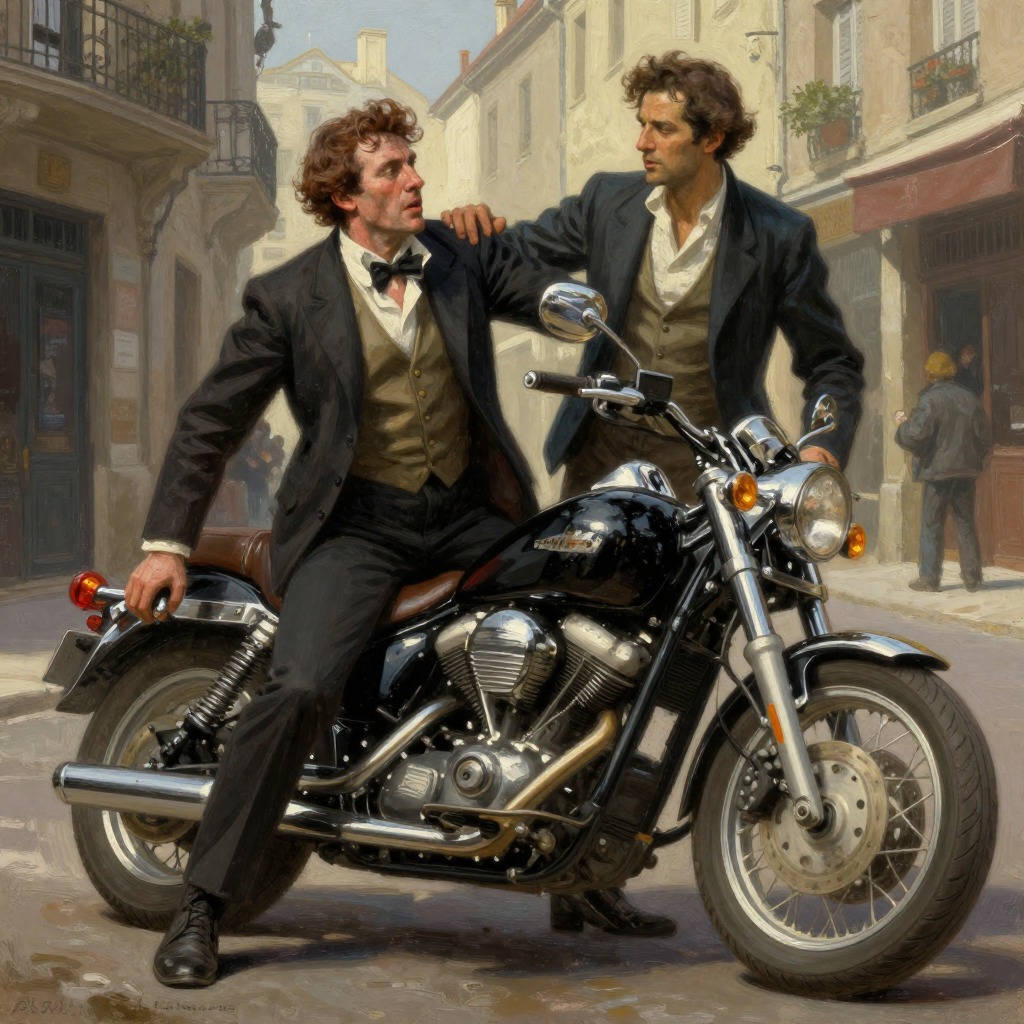
The confrontation occurred when Clamence, driving his car, was slow to move at a green light. A small man on a motorcycle, wearing spectacles and plus fours, had stalled his engine in front of him. When the light changed, Clamence asked the man, with his usual courtesy, to move aside. The motorcyclist, irritated by his wheezy engine, replied with a crude insult. Clamence insisted, his politeness giving way to impatience, and was told to go to hell. As horns began to sound behind him, Clamence got out of his car with the intention of thrashing the man, believing his muscles and height gave him the advantage. However, before he could act, a man from the gathering crowd rushed at him, declaring that Clamence was the lowest of the low and would not be allowed to strike a man at a disadvantage with a motorcycle between his legs. As Clamence turned toward this new antagonist, the motorcyclist started his engine and struck Clamence a violent blow on the ear. Dazed and with the horns of the waiting traffic now an exasperated concert, Clamence docilely returned to his car and drove off, passing the man who had intervened and hearing him call out "poor dope."
The Aftermath and Imagined Revenge
The incident left Clamence deeply unhappy, as if he had violated a code of honor. He could not forget the image of himself getting back into his car without a reaction, under the ironic gaze of a crowd, especially as he was wearing a very elegant blue suit. The "poor dope" struck him as justified. In the days that followed, he ran a little film in his imagination a hundred times, seeing himself felling the intervening man with a good hook to the jaw, pursuing the motorcyclist, overtaking him, and giving him the licking he deserved. This bitter resentment chewed at him for several days, a stark contrast to his previous self-assurance.
The Revelation of True Desires
When Clamence recovered the recollection of this episode, he realized what it truly meant. His dream of being a complete man who managed to make himself respected in his person as well as in his profession—half Cerdan, half de Gaulle—had not stood up to facts. The desire to dominate in all things, which he had assumed was a matter of intellectual and moral superiority, was revealed to be something far more elementary. He discovered in himself sweet dreams of oppression, a wish to beat anyone he wanted, to be the stronger in the most basic sense. The truth, he concluded, is that every intelligent man dreams of being a gangster and of ruling over society by force alone. This realization shattered his self-image as the predestined defender of the widow and orphan, for he learned that he was on the side of the guilty only as long as their crime caused him no harm. When threatened, he became not a judge but an irascible master wanting to strike down the offender.
Connection to the Broader Crisis
The Motorcycle Confrontation is one of several key memories that surface after the mysterious laugh on the Pont des Arts, contributing to Clamence's growing distrust and sense of vulnerability. It is part of the process by which he realizes that his fellows are not the respectful public he had imagined, but a line of judges. The event demonstrates that his desire for a complete life, one where he could dominate in all things, was a lie. It forced him to see that his true desire was not to be the most intelligent or generous, but to be the stronger, and that his entire life had been a performance of a role he could not sustain. The confrontation, therefore, is not just a story of a failed fight, but a crucial step in Clamence's descent into the little-ease, where he must confront his own guilt and the judgment of others.